

Let's Recycle Correctly
Richmond Recycling Audits & Contamination Tags
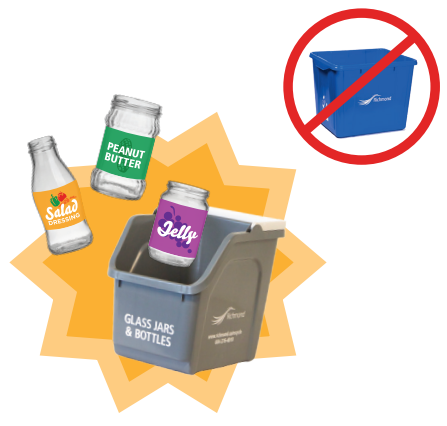 The City of Richmond is proud to provide residents with convenient curbside recycling services for paper, mixed containers and glass bottles and jars. As the City advances its Circular City Strategy, sorting materials is more important than ever.
Recycle BC has identified that Richmond has a contamination rate of 7.3% for the curbside stream and 11.3% for the multi-family stream—both above the allowable threshold.
Richmond must reduce recycling contamination levels by 25% by the end of 2026. If the target is not met, the City may face financial penalties that could affect utility costs for residents.
Contamination Information
What is contamination?
- placing glass bottles or jars in your Blue Box.
- putting books in your yellow mixed paper bag.
- recyclable items in a plastic bag and then placing the bag in your Blue Box.
Who is Recycle BC?
What is a recycling stream?
How does Recycle BC determine if there is contamination in Richmond’s recycling?
Where can I get more information about recycling?
- search the item through the Richmond Recycle Search or use the Recycling Wizard on the free Richmond Recycling app;
- call 604-276-4010 or;
- email garbageandrecycling@richmond.ca for more information.
What should I do if I don’t know how to recycle something?
-
Before you put an item where you think it might go, you can double check by:
- searching the item through the Richmond Recycle Search or use the Recycling Wizard on the free Richmond Recycling app;
- calling 604-276-4010 or;
- emailing garbageandrecycling@richmond.ca for more information.
 Oops Campaign: Curbside Audits & Enforcement
What is the City doing to reduce recycling contamination?
If your recycling has contamination, you will receive an Oops tag and additional information.
How can I help reduce recycling contamination?
I received an Oops tag about glass in my Blue Box, what does that mean?
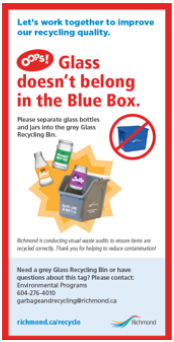 This Oops tag means that the recycling audit team found a glass item in your Blue Box. Glass bottles and jars go in the grey Glass Recycling Bin. If you received this tag you’re welcome to call 604-276-4010 or email garbageandrecycling@richmond.ca to learn more.
 I received an Oops tag about bagged recyclables, what does that mean?
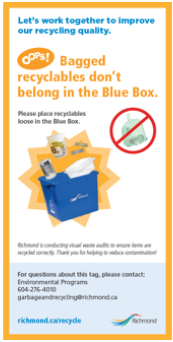 This Oops tag means that the recycling audit team found bagged recyclable items in one of your recycling bins. Please place items loose in your recycling bins. If you received this tag you’re welcome to call 604-276-4010 or email garbageandrecycling@richmond.ca to learn more.
I received a different Oops tag, what does that mean?
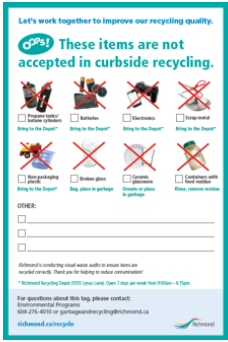 There are a number of common contaminants our recycling audit team is on the lookout for, and those Oops tags are a reminder not to place these items in your recycling. If you received an Oops tag you’re welcome to call 604-276-4010 or email garbageandrecycling@richmond.ca to learn more.
 | Oops Item | Why did a get an Oops tag? | How to recycle/dispose of this item correctly |
|---|---|---|
 Propane tanks/ butane cylinders Propane tanks/ butane cylinders |
Hazardous item - not accepted in curbside/multi-family recycling as it is dangerous/explosive. |
Drop off all of these items at the Richmond Recycling Depot 5555 Lynas Lane
|
 Batteries Batteries |
Hazardous item - not accepted in curbside/multi-family recycling as it is dangerous/explosive. | |
 Electronics Electronics |
Not accepted in curbside/multi-family recycling. Potentially dangerous. | |
 Scrap metal Scrap metal |
Not accepted in curbside/multi-family recycling. | |
 Non- packaging plastic Non- packaging plastic |
Not accepted in curbside/multi-family recycling. | |
 Broken glass Broken glass |
Not accepted in curbside/multi-family recycling. | Please wrap and place items into the garbage. |
 Ceramics/ glassware Ceramics/ glassware |
Not accepted in curbside/multi-family recycling | Consider donation. If item not in gifting condition, wrap and place into the garbage. |
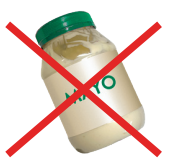 Containers with food residue Containers with food residue |
Too much food residue makes an item too hard to recycle. | Please empty and rinse containers before placing items in the recycling bins. |
 Other Other |
Another item could be indicated on your Oops tag, please call 604-276-4010 for more information and recycling instructions. |
|
I received an Oops tag and my recycling was not picked up, what does that mean?
Common Contaminants
Recycling Tips
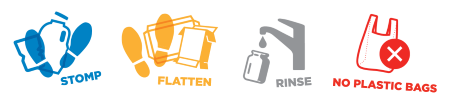
- Empty and rinse containers to remove any food residue.
- Flatten containers so they don't take up a lot of space in the recycling bin and collection truck.
- Cut cardboard to smaller pieces.
- Remove lids and recycle separately in the Blue Box or Containers Recycling Cart It's important to place glass bottles and glass jars in the grey "Glass Recycling Bin or Glass Recycling Cart".
- Do not mix glass together with plastic or paper containers because glass can break easily and leaving small fragments of glass pieces in other recyclable items.
- Do not put recyclables into plastic bags. Collection and processing staff will not break open the plastic bags to take out recyclable items due to safety concerns. Bagged items will go in the garbage.
- Avoid stacking or nestling of different materials together, instead place them separately in the bins. For example, don't nestle an aluminum can inside a plastic container.
The City also offers free recycling workshops to any community groups, please email garbageandrecycling@richmond.ca for details.