Hapa Collaborative
,
Joseph Fry
4011 Moncton St.
Area:
Steveston
Location:
The artwork is integrated into the landscape West of the Steveston Tram building at One Road and Moncton Street in the Steveston Park. The site marks where the Steveston Japanese Community left from during the period of internment.
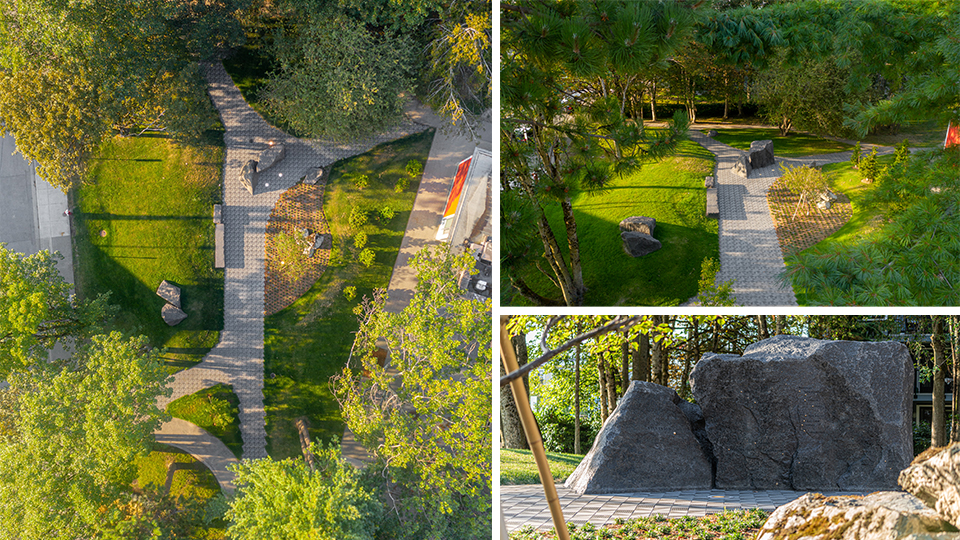 Photo by the Artist
Materials:
Engraved granite boulders with bronze markers, basalt stone basin, basalt paver pathways, plum trees, mondo grass and lawn covered landform.
Program: Donation
Ownership: Civic
Sponsored By: City of Richmond
Also Known As: Steveston Nikkei Memorial
Description of Work
This Nikkei Memorial marks the 75th anniversary of the forced removal of Steveston’s Japanese Canadian community in 1942, during World War II. More importantly, it celebrates the 70th anniversary of their return as members of a resilient community and honours their contributions in rebuilding Steveston.
Artist Statement
As a third generation Japanese Canadian and landscape architect, Joseph Fry has a long and deep-seated interest in understanding the impact of the internment on his maternal grandparents. The design of the memorial seeks the intersection between culture and tradition, community and ethnicity, and private stories with public history. Research and investigation revealed these themes to the user, built a multiplicity of meaning and ultimately developed a deeply personal connection to place.
The memorial consists of three main elements referring to Japanese garden traditions but interpreted in a contemporary manner.
The Ume Trees: Ume is a plum tree native to Wakayama prefecture, where many of the Steveston Japanese community emigrated from in the early twentieth century.
The Stones: The basalt boulders were selected from near Tashme, where approximately 2,000 Japanese Canadians were interned. The central granite boulders symbolize the split between home (Steveston) and internment (internment camps, POW camps, along with a constellation of smaller sites), and the tearing apart of families.
The Paving: The patterns of the pavers draw inspiration from origami placemats made by a group of 90-year-old women in the interned community. The salmon can labels are woven into a pattern called ishidatami-ami, or “stone weave pattern”. It is a reminder of the understated strength and resilience of our Issei and Nisei ancestors.
This memorial honours the stories of our ancestors, in particularly the women of the community, who held families together despite the terrible living conditions and still today, weave these beautiful artifacts 75 years after the internment.
 Translate