Untitled [Nest for Owls] (2016)
Alyssa Schwann
,
Michael Seymour
9728 Alexandra Road
Area:
East Richmond
Location:
The piece can best be viewed from the south side of the Jayden Mews townhouse development on Alderbridge Way.
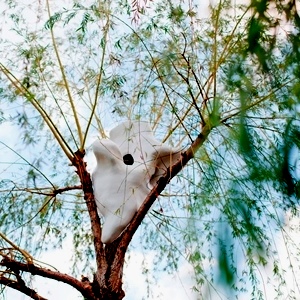 Photo by Janis Nicolay
Materials:
Nest: Fiberglass, polyester resin, porcelain dust, polyester gelcoat, rubber gaskets, polyurethane varnish
Collar: Expanded polystyrene foam, polyurethane adhesive and acrylic coating
Program: Private
Ownership: Private
Sponsored By: Polygon Development 296 Ltd.
Also Known As: Nest
Description of Work
The design for the nest was initially developed in response to the need for the establishment of an ideal habitat, not only for the owls, but also for their food sources. Utilising natural elements in the design was a method of integrating the nest in its peri-urban environment. A pollarded willow tree was envisioned to house the nest due to its fast-growing characteristics, suitability for the site, and historic agricultural presence. Traditional pruning and pollarding techniques were be to shape the willow trees over time into ornamental expressions.
The nest itself is a ceramic vessel modelled from an existing tree nest and the ideal dimensions for a safe and habitable nesting site. In addition to the ease of modelling and production provided by ceramic, nests will easily be replicated. Conceived of as a series of recognisable features (‘jewels’) distributed throughout the community, the vessels could also provide habitat for other wildlife, such as birds.
Artist Statement
In many parts of the world, including British Columbia, Barn Owls are threatened, rare and in decline. This is due to multiple factors, including loss of habitat from development pressures, a loss of traditional nesting areas and impacts from climate change. Replacing the owl’s natural habitat with a pole box is often inadequate. With this in mind, it was determined that the habitat should be more permanent in nature in order to best serve the Barn Owl and mitigate future risks.
 Translate